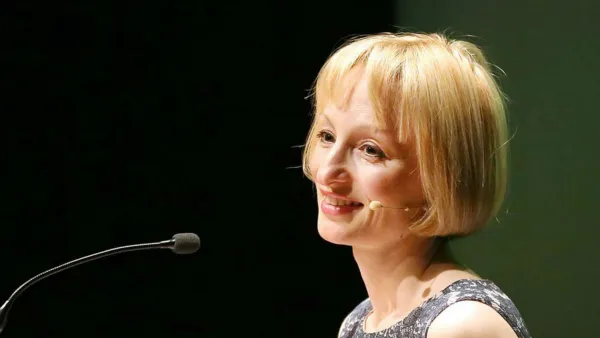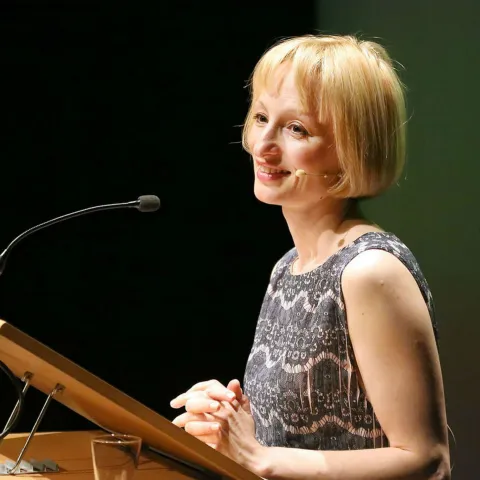
Literary scholar Sanja Bahun inaugurates the Center for the Humanities’ new Global Humanities Lecture on Tuesday, April 28, with the her talk, “Modernism and Home, with Notes on Method.” Bahun is a professor of literature and visual arts and the executive dean of the Faculty of Arts and Humanities at the University of Essex in the UK. Her area of expertise is in international modernism, with research interests covering the theory of comparative arts, world literature, psychoanalysis, and women’s and gender studies. In her talk, she will discuss the ways in which a range of modernist artists and thinkers both nourished and responded to significant paradigm shifts in our thinking about home at the beginning of the 20th century and reflect on the opportunities and challenges of using comparative methods to discuss them.
The new lecture series complements the humanities center’s longstanding lineup of annual lectures, the James E. McLeod Memorial Lecture on Higher Education and the Faculty Book Celebration Lecture. The new event will bring a humanities scholar from a non-U.S. institution working on a topic of global interest.
“We see this lecture as bringing new voices onto campus from different national institutional contexts that can bring additional perspectives to our research here at WashU,” said Stephanie Kirk, professor of Hispanic studies and director of the Center for the Humanities. “We also see the existence of a signature event focused exclusively on global research as a way of elevating the already stellar global work our faculty conducts. By hosting these talks, we aim to foster dialogue, encourage interdisciplinary thinking and deepen understanding of the critical global challenges facing humanity today as well as drawing important connections between global and local issues.”
Not all speakers will attempt to chart commonalities, however. “While humanistic research can connect work from different regions comparatively or by focusing on humanistic responses to global grand challenges such as AI, climate catastrophe, authoritarianism or migration, for example, global humanities work can also serve to foreground local histories, languages or cultural artifacts, traditions and conditions that challenge globalization’s flattening effects by sharing specific knowledge in a global context,” Kirk said.
About the speaker
Sanja Bahun has an extensive and influential body of published work on global topics including Modernism and Melancholia: Writing as Countermourning (Oxford UP, 2014), Cinema, State Socialism and Society in the Soviet Union and Eastern Europe, 1917-1989: Re-Visions (2014), Violence and Gender in the Globalized World: The Intimate and the Extimate (Routledge, 2008, 2015) Thinking Home: Interdisciplinary Dialogues (Routledge, 2018, 2020) among others. Her recent Aktivitet: 100 Years of Surrealism (2024-25) exhibition at the Museum of Contemporary Art, Belgrade won the International Council of Museums' award for the Best Project in 2025.