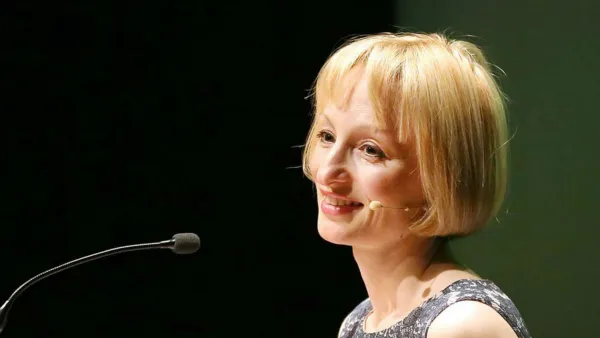

The Center for the Humanities is pleased to welcome environmental humanities scholar Daisy Reid to the WashU community. Reid recently joined the center as a postdoctoral fellow in the Modeling Interdisciplinary Inquiry program. This two-year Mellon-funded program is designed to encourage interdisciplinary scholarship and teaching across the humanities and interpretive social sciences.
Reid earned a PhD in comparative literature from the University of Southern California in 2025. She examines the curious interactions between plants and insects, writing for both scholarly and public audiences. She's also a traveler, a reader and a thrift store treasure hunter.
Below, we asked Reid about her research, her experiences with public-facing writing and her postdoc plans.
Tell us a little bit about yourself! What place or places do you call “home,” and what do you enjoy doing outside of work?
I have been lucky enough to call many different places “home” throughout my life, from a crumbling house-share in South London, to a tiny apartment in Amsterdam, to the sprawl of Los Angeles, to — most recently — the strange attic I inhabit here in St. Louis. But my true home, I think, will always be my parents’ house in Southeast England. Whenever I feel like I want the comfort and familiarity of home, that is the place I am most pulled toward.
Outside of my work, I enjoy traveling, reading, writing letters and seeking out treasures in thrift shops.
What are your academic interests? What drew you to these topics?
I would broadly consider myself a scholar of the environmental humanities, but my particular interest is the strange, obscure interactions between plants and insects. I have long been fascinated by the patternings and formations that emerge as these two life forms — both of which already feel almost alien in their radical alterity to the human — come together in ecological processes such as pollination, parasitism, plant insectivory and infestation. These encounters can be destructive and productive, affect-laden and erotic, life-giving and life-taking. And we might not consciously think about them all that often, but they are constantly unfolding around us, constantly shaping the world around us and the lives we live within it. I find that insects and plants hide in plain sight, mediating us without ever fully being acknowledged as mediators. This subtle kind of action, the sheer peculiarity and illegibility of it all, is what drew me to the topic. I find it baffling and exciting.
And I’m not the only one! My current book shows that thinkers in transnational Europe have been deeply preoccupied with plant and insect life since at least the Scientific Revolution. I study the varied (and often frustrated) attempts to make sense of these interrelated life-forms in the domains of science, philosophy, literature and poetry, particularly amid the rise of empire and modernity. I want to show that the principles of gender, sexuality, race and class have historically been mediated in emergent, unexpected ways through our experiences of interacting plant and insect life.
Your work has also been published in more public-facing venues, including PBS. What have you enjoyed (or found challenging!) about writing for more general audiences as a scholar?
When people outside of the academy ask me what I study, I always respond with “I work on plants and insects in literature.” More often than not, I am met with a reaction of surprise. Occasionally, I’ll get a comment like, “I didn’t know you could study something like that.” The environmental humanities is still a relatively new field, and it is easy to forget that it is not well known outside of specific circles. And yet this kind of inquiry allows us to investigate, for example, how the exploitation of environments and the marking of certain human bodies as disposable, extractable or invisible go hand in hand. It reveals how the cultural narratives we tell about ecologies help to naturalize certain human desires; it reveals how sci-fi helps us conceptualize the vast spatiotemporal scales of climate change; it reveals the provocative, some might even say utopian, possibilities of thinking with plants and fungi. In a time of ongoing environmental catastrophe, these intriguing, consequential avenues of thought are not just relevant to scholars. They matter for everyone. And writing for general audiences is an important way of both recognizing and responding to this.
I have to acknowledge the work of the Civic Paths collective at the University of Southern California for really allowing my interest in more public-facing scholarship to take root. As a group, we engage with the concept of the “civic imagination” — that is, the ability to imagine different and better futures as part of a collaborative and creative practice. This kind of scholarship works only if audiences beyond the academy are invited to engage, respond and build on it, if ideas are allowed to circulate outside of expensive lecture halls and niche academic journals and into the everyday spaces where imagination and civic life meet. Writing for a general readership comes with its challenges, of course. I didn’t quite realize how much I rely on academic jargon until I had to avoid using it altogether. Now that I am finished with my dissertation, I am really excited to produce more public-facing scholarship during my time at the Center for the Humanities. I am hoping to push myself and give some in-person talks and lectures to non-academic audiences as well.
What will you be working on during your postdoc here?
I will spend much of the next two years writing my book, tentatively titled “On Vegetables and Vermin: The Politics of Insect-Plant Encounters from the Early Modern to the Anthropocene.” I am also planning to put together a few public-facing pieces of writing — I have ideas for a short article about plant monsters, and another about the sci-fi precedents for AI lovers — and I am working with my brilliant fellow postdoc here at the center, Candace Borders, to organize a conference panel about the more-than-human politics of plantation monocultures. Next semester, I am excited to teach my first undergraduate seminar here at WashU, which will bridge scholarship in the environmental humanities and literary studies with intersectional gender and sexuality studies. Keep an eye out for it on the spring 2026 class schedule!
About the author
Naomi Kim is a PhD student in the Department of English and a Lynne Cooper Harvey Fellow in the Program in American Culture Studies. She is completing a mentored professional experience (MPE) in the Center for the Humanities in fall 2025.