2024–25
VIDEO
Caroline Sturdy Colls
“The Evolution of Mass Murder: Forensic Archeological Perspectives on Mass Violence at Treblinka Labor and Extermination Camps”
Why Treblinka, part of ‘the largest single murder campaign within the Holocaust,’ remains unknown to Americans, by Erin McGlothlin
2023–24
Ari Joskowicz
“Roma, Jews, and the Holocaust”
2022–23
Jeffrey Veidlinger
“The 1918-1921 Pogroms in Ukraine and the Onset of the Holocaust”
Ukraine and a forgotten chapter in Holocaust history, by Sylvia Sukop
2021–22
VIDEO
Natalia Aleksiun
“Jewish Physicians and Their Patients: Rescue Strategies in Nazi-Occupied Poland”
2020–21
Virtual Roundtable with Avril Alba, Zahava D. Doering and David Cunningham
“Legacies of Violence and Genocide: Can Memorials and Museums Help Us Build a Better Future?”
On Legacies of Violence, Genocide, and Implicated Subjects: Arts and Museums as Influence and Response, by Deniz Gündoğan İbrişim
2019–20
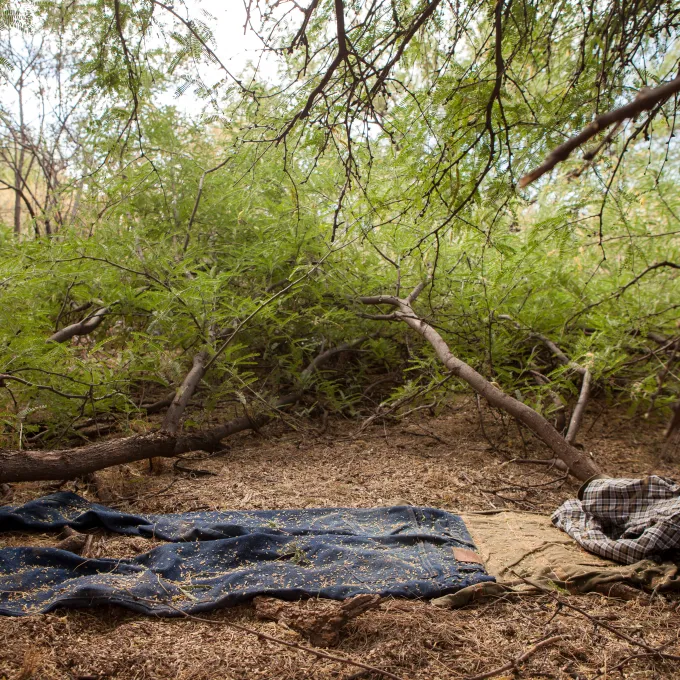
Jason De León
“The Land of Open Graves: Understanding the Current Politics of Migrant Life and Death along the US/Mexico Border”
On Borders and Unnatural ‘Natural’ Deaths, by Tabea Linhard
2018–19
Sue Vice
“The Holocaust in Literature and Film: Revisiting Claude Lanzmann’s Shoah”
Claude Lanzmann’s Shoah and Its Archive of Outtakes, by Erin McGlothlin
2017–18
Crystal Feimster
“The Greatest Outrage of the Century: White Violence and Black Protest in in America”
‘A Time to Lift One’s Voice’: The East St. Louis Riot in a Migration Perspective, by Douglas Flowe
2016–17
Doris Bergen
“Holocaust or Genocide: Uniqueness and Universality”
The Holocaust and the ‘Whew’ Effect, by Erin McGlothlin
2015–16
Jay Winter
“The Holocaust and the Armenian Genocide”
Violence and Memory, with Anika Walke and Jay Winter
2014–15
David Shneer
“Through Soviet Jewish Eyes: Photography, War and the Holocaust”
2013–14
Sarah Wagner
“Srebrenica’s Legacies of Loss and Remembrance”
2012–13
Aron Rodrigue
“Some Reflections on Sephardic Jewries and the Holocaust”
2011–12
David Rosen
“The Moral Complexity of the Child Soldier ‘Problem’”
2010–11
Marianne Hirsch
“Rites of Return: The Afterlife of the Holocaust in Jewish Memory”
2009–10
Benedict Kiernan
“Blood and Soil: Genocide in World History”
2008–09
Daniel Mendelsohn
“Finding ‘The Lost’: A Journey into the History, Family, and Judaism”
2006–07
David Rieff
2005–06
Christopher Browning
“Holocaust Denial in the Courtroom: The Historian as Expert Witness”
2004–05
Peter Balakian
“The Armenian Genocide and America’s First International Human Rights Movement”
2003–04
Adam Hochschild
“The Holocaust and the Congo: Then and Today”
2002–03
Jan Gross
“Neighbors: The Destruction of the Jewish Community in Jedwabne, Poland”
2001–02
James E. Young
“A Holocaust Memorial for Berlin?”
2000–01
Philip Gourevitch
“The Rwandan Genocide”
1999–00
Saul Friedländer
“The SHOAH: Memory, History and the Historian”
1998–99
Louise Arbour
“Prosecutions before the International Criminal Court”
1997–98
Michael Berenbaum
“The Holocaust and its Remembrance”
1996–97
M. Cherif Bassiouni
“Stopping Impunity for International Crimes”
1995–96
Steven Katz
“Holocaust and Mass Death: Variations and Differences”
1994–95
Ernst Stein
“The Rise of Neo-Nazism in Germany”
1993–94
Ian Hancock
“Gypsies, Germany and the Holocaust”
1992–93
Elie Wiesel
“When the Unthinkable Happens”
1991–92
William Shawcross
“Holocaust and Cambodia”
1990–91
Robert Jay Lifton
“Beyond Genocide – Learning from the Nazi Doctors”
1989–90
Arno Mayer
“Terror and Violence under Hitler and Stalin: Issues in Studying the Holocaust”