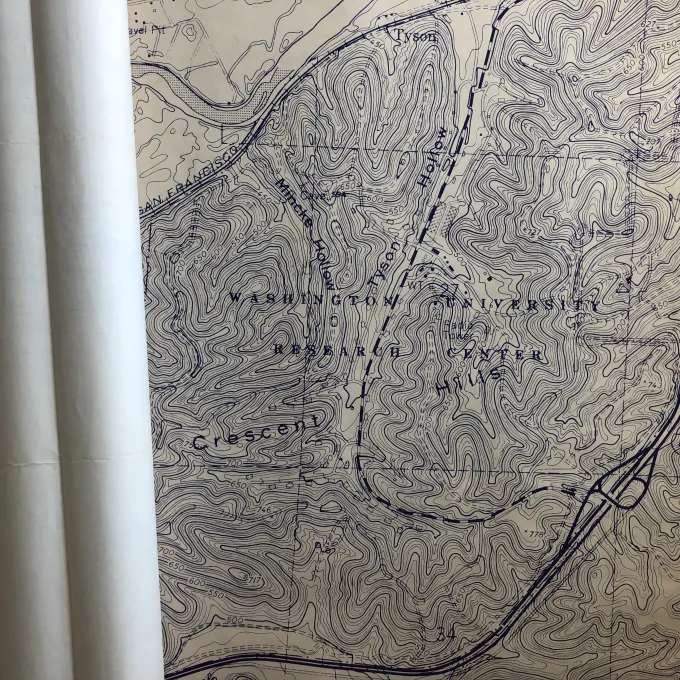
CHESTER is a collaboration between the Center for the Humanities, the program in Environmental Studies, and Tyson's environmental research initiatives that supports the Tyson History Project — an ongoing collaboration between humanists at WashU and science teams at Tyson to more fully understand the vast and complex human histories of land that now serves as the Tyson Research Center. A group of undergraduates will work on projects related to topics in environmental humanities, using archival materials from WashU’s Tyson Research Center field station as a key source for their explorations.
Why Tyson?
The 2,000-acre wooded landscape has a rich and varied history of human activity, from centuries of Indigenous use to settlement by white Americans (some of them enslavers) in the 19th century, to its acquisition by the U.S. military and use as a site for storing and testing of munitions during World War II. In 1963, WashU acquired the land from the military and began to use the area as a field station for ongoing environmental research. In addition, Tyson facilities were occasionally used for storage by the Danforth and Medical School campuses. As a research site for primarily biological field work where researchers explore the adaptability and resiliency of various species and topographies in relation to human intervention, Tyson is also a site for broader human speculation about our past, present and future on a changing planet.
It is for these reasons that the Tyson Research Center materials offer significant archival and research opportunities for our undergraduate students.
Click here to learn more about the ongoing Tyson History Project.
Application & eligibility
The Center for the Humanities and Environmental Studies invite interested undergraduate students into this conversation. The CHESTER fellowship is open to undergraduates at every level and every major in Arts & Sciences. Applications for the fall 2026 fellowship are accepted on a rolling basis until midnight, Friday, August 7, 2026.
About the fellowship
Students in this project will be immersed in an active, ongoing archival research project to uncover and interpret aspects of Tyson’s history. Each semester, the specific research focus changes as research priorities unfold. Regardless of topic, the project work each student will undertake is three-fold:
- Contribute to the archival processing project that describes and digitizes records crucial for developing a historical timeline of Tyson Research Center.
- Collaborate to meet the Tyson History Project’s research goals, including through working with local historians and archives.
- Contribute to the Tyson History Project’s ongoing researched written products and develop new areas of inquiry.
If you are interested in digging around in archives, gaining skills in processing and interpreting archival documents, the environmental humanities and humanities research more broadly, this fellowship is for you!
Students in this fellowship will meet biweekly on Fridays, 11 am-1 pm. Attendance at meetings is a requirement of the fellowship; we are unable to accept students who cannot meet on Fridays. Two of these meetings will be field trips out to Tyson to explore the site and will require a return time to campus of 5 pm; transportation will be provided.
All student project work will be mentored by humanities center staff and a graduate student mentor, and students will receive guidance on the humanities research process and the resources available to undergraduate humanists at WashU. Student fellows will enroll in the Environmental Studies program’s Directed Research course and receive 2 units of academic credit; they will also receive a $300 stipend.
Questions may be directed to Meredith Kelling, assistant director of student research and engagement, Center for the Humanities.