Inside a World War II-era bunker at Tyson Research Center, preserved birds, handwritten logs and mold-covered artifacts tell a story of science, stewardship and changing times.
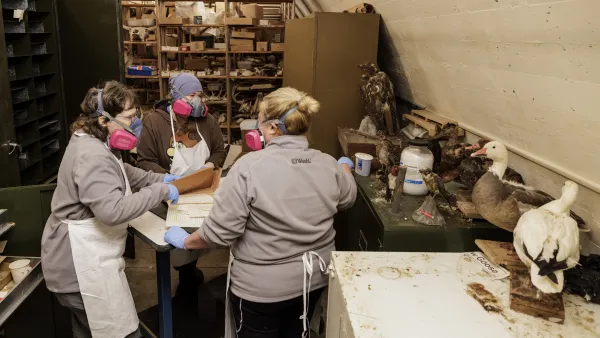
In the dim light of the concrete bunker, scientist and educator Susan Flowers and preservation librarian Danielle Creech peer into a faded red cooler. The smell of formaldehyde and mold hangs in the musty air. Wearing respirators, gloves and aprons, Flowers and Creech exclaim with excitement as they empty the cooler of their find: a preserved gull, its feathers surprisingly clean and white.
Taxidermied birds are everywhere in this bunker. There’s a small box of tiny hummingbirds, each one tagged with a different number. Preserved so perfectly, they wouldn’t surprise me if their wings started beating. I also spy a glassy-eyed owl and duck, among others, standing watch atop a filing cabinet.
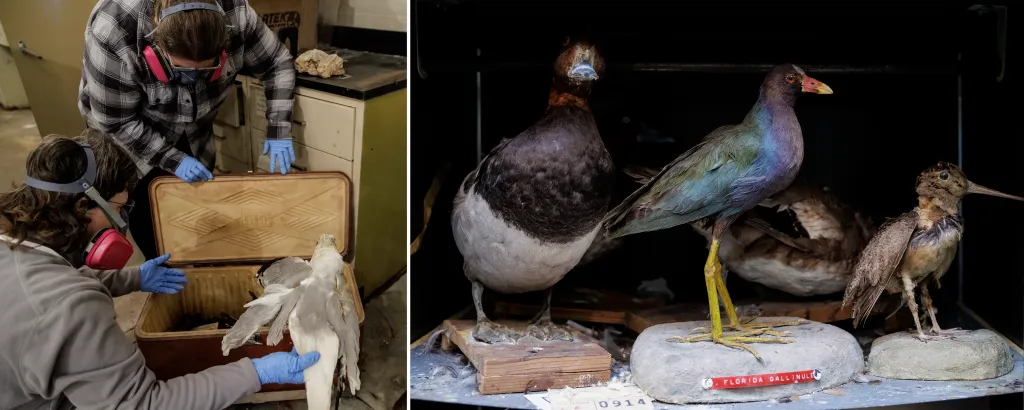
These birds were teaching specimens created or collected by Richard “Dick” Coles, a WashU professor and ornithologist. From 1970 to 1995, Coles served as the first director of Tyson Research Center, the university’s 2,000-acre environmental field station located in Eureka, Mo. This bunker — number 46 — is one of many hidden around Tyson’s landscape, a relic of its past as a military site before the university obtained it in 1963. Originally used for munitions storage during World War II and the Korean War, bunker 46 was subsequently designated as the WashU “library bunker” to hold overflow library materials from the main campus. Later, the structure transitioned in purpose to a “research bunker” where Coles and Tyson volunteers amassed a natural history collection. Coles also used the bunker for some time as his office, but the space has been left largely untouched since the 2000s. It’s been over 10 years since the bunker has had any air handling.
The varied uses of bunker 46 — and all the documents and artifacts it now holds — make it a useful “case study in times changing,” Flowers tells me. She’s been working at Tyson since 1994 and is its current education-outreach-inclusivity coordinator. Coles was one of her mentors, and his passing in December 2022, she says, made her realize that “we were losing folks who were holding a piece of Tyson’s history.”
After months of interdisciplinary planning and coordinating, Flowers has teamed up with several others to rescue materials in bunker 46 that might speak to that history. Her collaborators in this mission include Danielle Creech, head of preservation, processing and exhibitions for WashU Libraries; Sonya Rooney, the university archivist; and Meredith Kelling, assistant director for student research and engagement at the Center for the Humanities. Thanks to an Ignite Interdisciplinary Grant through WashU’s Here & Next initiative, the team has the means to carry out their project — including the personal protective equipment necessary to brave the moldy conditions of the bunker.
“I have a great deal of experience dealing with mold [through my work], but I had never felt like I was on the set of The Last of Us before,” Creech tells me later, referencing the post-apocalyptic show set in a world ravaged by a fungal infection. Flowers says she actually tried to document the bunker’s contents about 15 years ago — but the endeavor had to be abandoned because of the bunker’s conditions, even then. “The fumes were so bad we got headaches and had to leave,” she says. “The mouse urine smell and the moth ball smell were already so bad!”
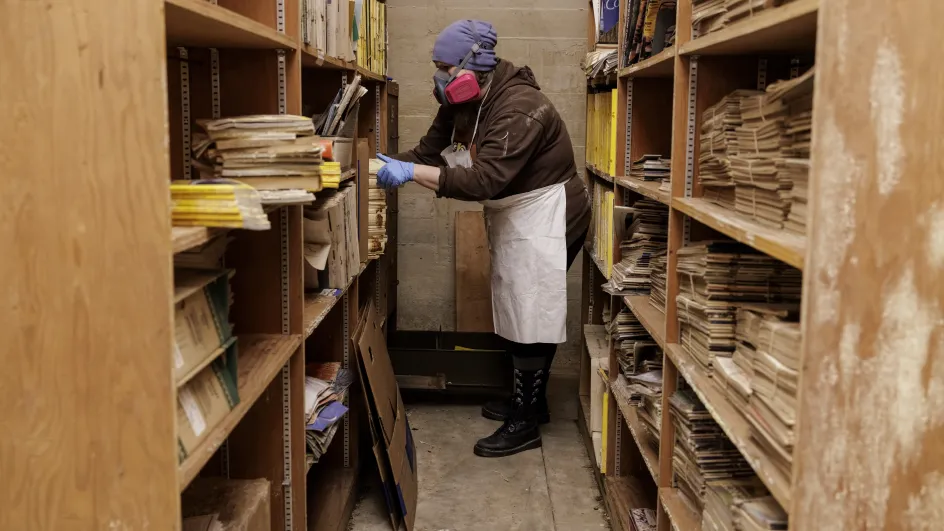
I’m grateful to have my own N95 mask as Kelling shows me around the bunker. Coles’ investment in building up a natural history collection at Tyson is immediately evident. In addition to taxidermied birds, there’s also a small frog skeleton, bones white and delicate, carefully laid out in a glass case. Shelves display animal skulls of varying sizes, some with antlers and horns, and bits and pieces of different bird nests. In the back are several large, rectangular cages and handwritten signs that warn, “Bird Trapping in Progress. Please do not linger in this area!” Coles’ old ornithology books are still crammed on the shelves, too: Life Histories of North American Woodpeckers; Life Histories of North American Birds of Prey; Life Histories of North American Thrushes, Kinglets, and Their Allies. Copies upon copies of National Geographic line yet more shelves, the magazines’ faded yellow spines fuzzy with little white clouds of mold.
“The 1970s brought out earthy people,” Flowers tells me with a laugh when I ask her how the natural history collections came to be. Rising eco-consciousness coupled with increased autonomy for women led to a local women’s group of self-taught botanists and nature enthusiasts. They became the “Tyson Toilers,” volunteers who tackled plant listings and bird sightings at Tyson. Various collections and catalogs related to natural history at Tyson thus expanded in part because Coles was generous and open, Flowers says: “He didn’t turn away people who had enthusiasm for the natural world, especially if they could donate their time.”
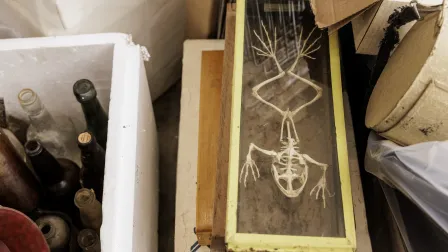
The bunker is thus a time capsule in more ways than one. Its contents attest not only to university activities and local history but also to shifts in the nation’s political and cultural currents throughout the 20th century. Moreover, Flowers says the bunker holds traces of even older histories that Tyson must also reckon with. She notes the presence of stone tools that speak to the Indigenous communities who lived on the land and developed quarry pits from about 10,000 BCE until about 1550 CE. Somewhere inside the bunker is also a replica of an atlatl or spear-thrower used by these communities. Glass bottles and other artifacts found in the woods and stored in the bunker help demonstrate and date colonial westward expansion into the area. Across the 19th century, ownership of plots of Tyson land connects the area to prominent St. Louis business leaders, including many who were enslavers. Extractive practices of logging and limestone quarrying followed, before the U.S. military claimed the area through eminent domain.
Outside bunker 46, Kelling and Rooney — both of them masked and gloved — sift through rescued documents to identify those that might be relevant for illuminating Tyson’s complex past. Many of these documents are in rough shape, discolored from mold and mice droppings. Mice have even chewed some of the papers into soft and pulpy nests. Amid these potentially biohazardous records, Rooney explains later, she’s looking for publications from Tyson, correspondence and reports about projects and happenings at Tyson, documentations about animals and plants and more. Once relevant items are identified and selected, however, they’ll need to be aired out and professionally cleaned if the physical records are to be kept in the university archives — a process that will likely involve irradiation to kill the mold, as well as surface cleaning. (Digitization, Flowers says, might be the way to go.)
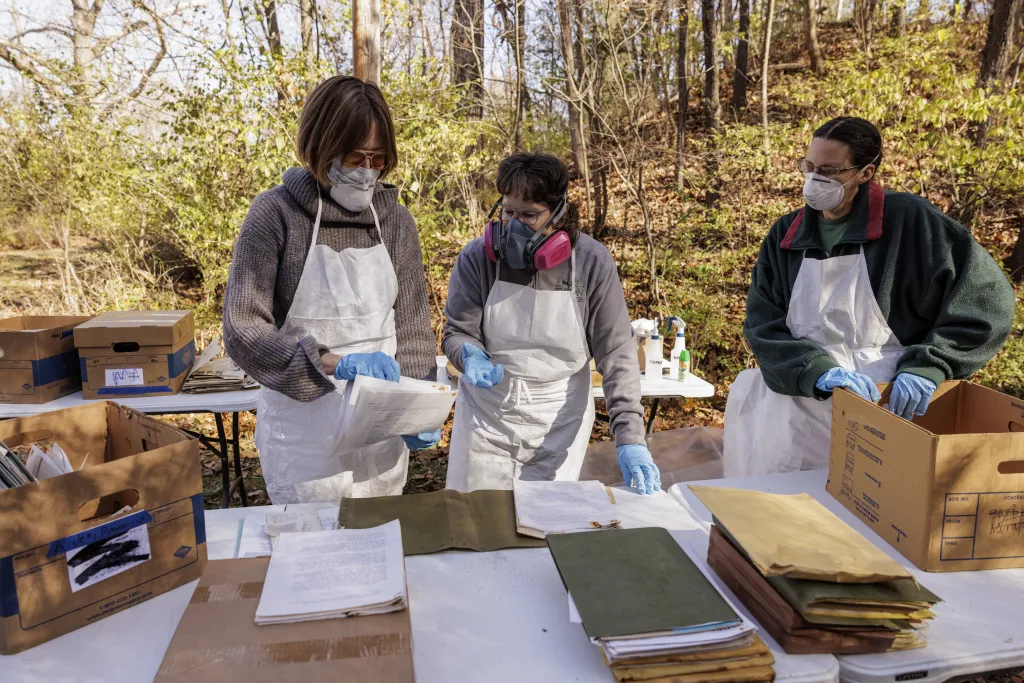
Over the course of three days of digging through the bunker, the team pulled almost 40 boxes of materials from the bunker. They’ve sent a subset of those boxes to air out at a warehouse. To protect those materials from mice, Creech and Lacey Kirkwood, the preservation supervisor for WashU Libraries, have built a cage around the boxes using mesh found at Tyson. Among the rescued items are some treasures that have left a particular impression on members of the rescue team: Creech tells me about a book from the early 1900s that put birdsongs into musical notation, while Rooney highlights a handwritten log documenting specimens collected at Tyson. “It shows a snapshot in time of the researchers’ work and the Tyson environment,” Rooney says.
“The ultimate goal is to make Tyson’s history accessible,” Flowers says as she reflects on the rescue mission. The materials from bunker 46 will support the wider Tyson History Project, a cross-disciplinary initiative to preserve, interpret and communicate Tyson’s history both before and since WashU’s presence on the land. Bunker 46 itself may eventually serve as an exhibition space to showcase that history.
For Flowers, revisiting all the objects left behind in bunker 46 through this project has also been an opportunity to experience anew her mentor’s dedication to building a field station at Tyson. “It’s cemented my absolute respect for Richard Coles,” she says. “He was an amazing steward of Tyson.”
Naomi Kim is a PhD student in the Department of English and a Lynne Cooper Harvey Fellow in the Program in American Culture Studies. She completed a mentored professional experience (MPE) in the Center for the Humanities in fall 2025.
Headline photo: Flanked by animal skulls and taxidermied specimens, member of the interdisciplinary team — from left to right: Susan Flowers (Tyson Research Center), Lacey Kirkwood (University Libraries) and Katie Westby (field station disease and vector ecologist, Tyson Research Center) — discuss a tranche of papers found in bunker 46. Photo: Whitney Curtis/WashU