
A new fellowship position with the Engaged City connects community and campus
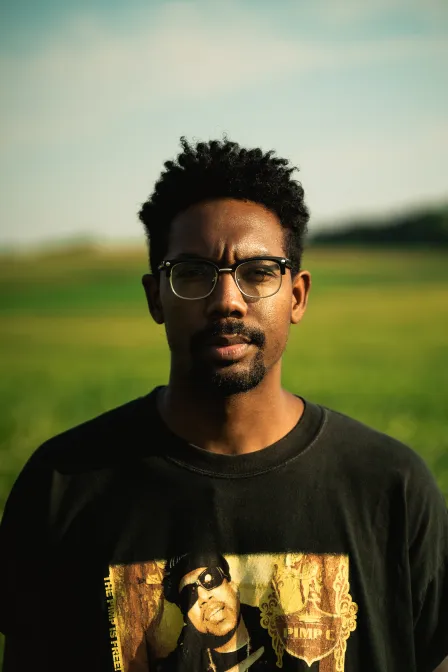
St. Louis artist Damon Davis is the kind of creator who defies easy categorization, blending visual art, music, film, performance and mythmaking into a practice that feels as urgent as it is poetic. His breakthrough public art project All Hands On Deck — a series of photographed hands pasted onto boarded storefronts along West Florissant Avenue during the Ferguson uprising — became a powerful symbol of resilience and has been recognized as a defining artwork of the decade. (A section of the work now resides in the Smithsonian’s National Museum of African American History and Culture, and the Saint Louis Art Museum also exhibited photolithographs from this series.) In the decade since then, he has continuously produced work that probes how identity is shaped by power, history and imagination, establishing him one of the most compelling voices in the region’s contemporary art scene.
Steeped in the city’s cultural richness and social struggle, Davis offers a valuable perspective, vision and skillset as a Community Fellow in Residence with the Engaged City, a Mellon-funded project of WashU’s Center for the Study of Race, Ethnicity & Equity; Center for the Humanities in Arts & Sciences; and Office for Socially Engaged Practice in the Sam Fox School of Design & Visual Arts. As one of three community members embedded in the organizing units, Davis will spend his fellowship at the humanities center contributing to the Engaged City’s new cultural asset map of St. Louis. Together with Engaged City team members and a community advisory board, the fellows will help create a publicly accessible cultural map of St. Louis (both digital and in print) that spatializes the city’s individual and collective knowledge bearers, places and practices that constitute its culture. It is a project intended to bridge divides, highlight existing resources, identify gaps and facilitate new connections.
Below, we asked Davis about his artistic work, his interest in the Engaged City’s mission and how the city has influenced his practice.
Tell us about your ethos as an artist. What work interests you? Does your past work have a common thread?
At this point in my career, my interests center on story and storytelling. I consistently explore three primary themes in my work: myth, identity and power. Using a range of creative approaches, I examine how these themes intersect and shape one another within society. These ideas form a consistent thread throughout my past and current work.
What draws you to the Engaged City’s mission? From your perspective as a member of St. Louis’ cultural community, what need does it fill?
I have lived in the Metro East and St. Louis area my entire life — this is home. The mission of mapping and documenting the city’s cultural hubs is both important and necessary for future generations, for creatives and residents alike. A city’s culture reflects its identity and values. Preserving cultural history helps us understand who lives here and what they believe in, which is why the Engaged City project fills an essential need.
What are you doing during your Engaged City fellowship?
During the fellowship, I plan to create an archive documenting the convergence of beat culture, hip hop and electronic music on Cherokee Street from 2010 to 2020. This story will be told through three key entities: two venues, 2720 and Blank Space, and one indie label and art collective, FarFetched. [Ed. note: Davis was a co-founder of this label.]
In what new ways does the fellowship contribute to your larger body of work?
The fellowship contributes to my larger body of work in two key ways. First, it allows me to document a formative period of my creative journey, helping to clarify the evolution and focus of my work. Second, it provides an opportunity to experiment with new materials and skills that I can apply to future projects.
How has St. Louis — the community and the built environment — influenced you as an artist?
St. Louis and its community are my primary sources of inspiration. My lived experiences here, along with the lives and stories of my friends and family, have shaped both my worldview and my creative practice. The experiences this region has given me continue to fuel the work I create.
