
Interview with Faculty Fellow Joseph Loewenstein
Edmund Spenser is one of those rare writers who didn’t just contribute to English literature — he helped define what an English literary tradition could be. A new, long-awaited collection of his works currently in progress by a team of editors including Faculty Fellow Joseph Loewenstein, professor of English, uses both traditional scholarship and digital innovation to provide fresh analysis of Spenser and his turbulent Elizabethan world. Here, Loewenstein offers an overview of the six-volume “Oxford Edition of the Collected Works of Edmund Spenser” to come and a peek at his current work on two of the poet’s most unsettled writings, Complaints and The Faerie Queene.

Who was Edmund Spenser?
Spenser was a major force in Anglo-American literary culture, not just a canonical poet but one whose career helped to establish the very concept of an English literary canon. His chief works figure in important ways in the histories of Reformation theology, of early modern printing and publishing, and of Renaissance moral, ethical and political theory, psychology, sexuality and representations of the human body.
His Shepheardes Calender, one of the earliest collections of pastoral poetry in English, inaugurated a quasi-Virgilian career that moved from short poems to a major epic, The Faerie Queene, a moral allegory devoted both to praise of Queen Elizabeth I and to the investigation of political responsibilities and spiritual urgencies of its complex historical moment. His prose treatise on Ireland is an indispensable document of early modern colonialism; so too are the narrative and lyric poems in which he presents himself as the first Anglo-Irish author.
Spenser’s texts are central documents in a tradition of literary and philosophical engagement with questions of public morality and of the political function of private ethics; as such, they take their proper place among the writings of Plato, Virgil, Cicero, More, Milton, Blake, Sartre and Rawls.
Tell us about the current Spenser collection. Why did it call for an update?
There hasn't been a collected works of Spenser for over a hundred years, and the scholarship around the poet has evolved. At that time, Spenser was thought to be, above all, an apologist for Elizabeth; the poet in our edition is more partisan, torn between Elizabeth and her policies and a group of aristocrats who served her loyally but critically.
Editing has changed a lot in the past century, too. When the other editors invited me to join them in the early 2000s, when no serious press would even think of involving itself in digital publishing, they asked what I thought could make this “an edition for the 21st century.” I talked about Spenser’s divided loyalties, about the need to situate the work more firmly within print culture, and about making this an edition both for print and for digital consumption. When we started, that last idea was more hope than firmly articulated plan. Thanks to my colleagues and students in WashU’s Humanities Digital Workshop (HDW), our edition is centrally a digital practice and product, with the print edition a kind of traditional derivative.
During your fellowship, you’re working on two volumes of his writing, Complaints and half of The Faerie Queen. Tell us about these works and what will readers find in your new edition.
Spenser is best known for his epic, The Faerie Queene, long recognized as a central contribution to the so-called cult of Elizabeth and, more recently, to English strains of male feminism. Our edition will decenter this somewhat by observing how resolutely the poem sustains an allegiance to Leicester, the Sidneys and to the militant Protestant internationalism that struggled against Elizabeth’s fiscal, military and diplomatic caution.
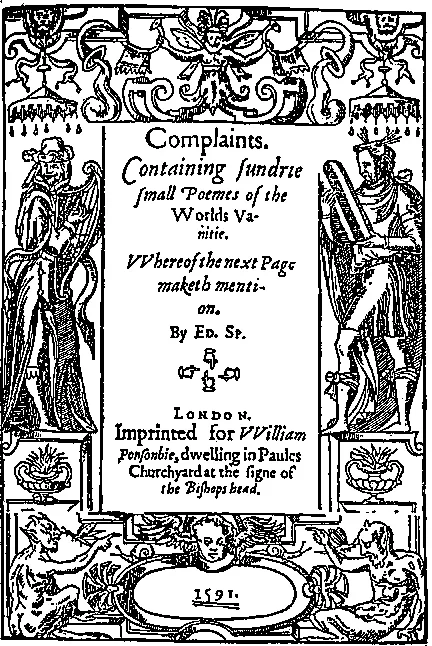
Complaints captures him at a strange moment in his career. The first installment of The Faerie Queene had just appeared. It was the first modern English epic and Elizabeth rewarded him for it, but her secretary of state, Lord Burghley, disdained it, and Spenser knew it. Moreover, many of the people who had patronized him a decade earlier had died, so he feels success and exposure. Complaints mourns those who have died, attacks Burghley, and updates his early works (detaching them a bit from their radical associations). He wrote the poems for this volume while working on the second installment The Faerie Queene, and they’re tangled together in ways that other scholars haven’t noticed.
Complaints gathers several moderately long poems and poetic sequences into a loosely coherent collection concerned with the fragility of earthly achievement. Two of the sequences are revisions of the translations that Spenser did as a teenager. One poem, sharply satiric, attacks figures who are plainly identifiable as William Cecil, Lord Burghley and his son Robert, and, because of the poem, the book was recalled and was reissued with the offending poem removed.
After Complaints, Spenser returns to the second half of The Faerie Queene, which is much more critical of Elizabeth than is the first. There’s something rattled about it that fascinates me. When the other editors and I were choosing which parts of the corpus we wanted to take on, the others fought over the first half of the epic. I only wanted the second half, and none of them did. I wanted this part of Spenser’s career, the dissonant part.
The entire collected works will eventually constitute six volumes, edited by five scholars in four states and two countries. How does that work?
It’s tough to organize. We write together, we edit each other, we disagree. Humanists aren’t used to collaboration. I’m lucky, having learned to collaborate by dint of constant work with the staff and students of the HDW: they’ve made me especially enthusiastic about collaboration. (Some of my fellow editors are less so.)
This new edition is a massive project and has been underway for decades. Tell us about how it has evolved over the years — some of the decisions the editors have made along the way and affordances made possible by new technology.
There are two decades of stories to tell. One involves an internal argument over whether to modernize the spelling of the poems. It’s customary to do so with other Renaissance poets and playwrights: Almost no one — and certainly no beginning student — reads Shakespeare, Donne or Margaret Cavendish in an old-spelling edition. It took me a while to persuade my colleagues to do some modernizing, but even I had misgivings about this, since Spenser is an archaizing poet. Paradoxically, he broke with his peers and asserted his cultural nationalism by self-consciously imitating poets like Chaucer, who had died a century and a half earlier. (Imagine a modern novelist choosing to sound like Melville!) So, some of Spenser’s vocabulary is old-fashioned. I don’t think that argues for preserving al olde spellings. A colleague and I did some pretty complex statistical work to demonstrate that Spenser’s spelling was no stranger than Shakespeare’s: What carries the archaic signal is the vocabulary, not the spelling. Anyway, we finally agreed and set out to modernize the texts. But when Oxford University Press (OUP) sent our samples out for review, the scholarly community insisted that we stick by established scholarly convention and produce an old-spelling text, which we’ve done.
But the edition on the online Spenser Archive does both: We have two texts, olde and “regularized.” This is one of the affordances of digital scholarship: We have a choose-your-own edition. It took time to build the infrastructure, but it’s an open-access edition (as we promised our first patron, the National Endowment for the Humanities), much richer than OUP can offer. Where a traditional edition refers, in its cryptically technical critical apparatus, to minute features of the earliest printed copies that influence hundreds of small textual decisions, we can present scanned images of dozens of copies of first and second and third editions that help us decide what Spenser and his publishers meant for us to see. Instead of asking readers to “trust us,” we’re able to “show our work.”
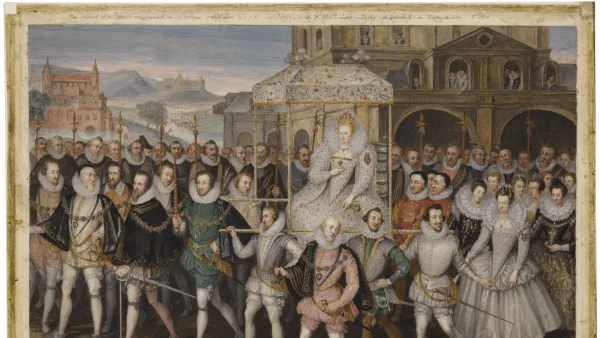
Headline image: Procession portrait of Elizabeth I of England (ca. 1600) by George Vertue. Public domain via Wikipedia.


