Through the Divided City Summer Graduate Fellowships, graduate students in the humanities are bridging the gap between academia and the broader public, building community and new skills in the process.
Today, it’s more urgent than ever for humanities scholars to connect with local communities beyond the university walls. From St. Louis to Nairobi and beyond, graduate students have been doing just that — all thanks to the Divided City Summer Graduate Fellowship (now known as the Public Humanities Graduate Summer Research Fellowship).
Now in its second year in this iteration, the fellowship program is funded by the Office of the Provost and gives graduate students the opportunity to “design projects and collaborations with the world of people outside of our campus who yearn for meaning as much as we do here,” says Meredith Kelling, assistant director for student research and engagement in the Center for the Humanities. In the process, graduate students also learn to think beyond the scope of their academic training.
This year’s Divided City Fellows recently gathered to present their projects at a colloquium, sharing stories and lessons from their vibrant experiments in collaborative meaning-making. Hailing from varied disciplines, including art, archaeology, comparative literature and sociology, the fellows provide a glimpse into the breadth of humanistic inquiry that the university supports. Accordingly, their projects reflected not only the range of these research interests but also the diverse and dynamic forms that publicly engaged humanities can take.
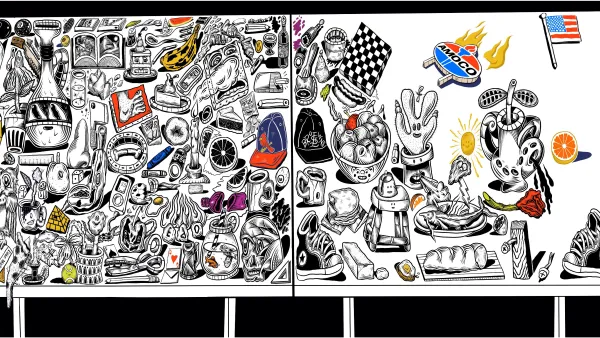
Several fellows, for instance, turned to artistic collaborations and outputs. Stephanie Nebenfuehr (Comparative Literature) worked with a local artist Edo Rosenblith to design a mural that would honor the history of the Lewis Collaborative, a co-working and housing space owned by Washington University. To nod to the building’s past as a women’s art institute offering pottery classes, the mural includes images of vases and ceramics tucked away amid other St. Louis-inspired objects. Working with a very different medium, Carmen Ribaudo (Sam Fox) spent five days teaching and creating sand animations while traveling down part of the Mississippi River on a boat. Rebecca Weingart (Comparative Literature), on the other hand, centered the literary arts: She researched Yiddish literary journals before soliciting different translations of a single Yiddish poem to make her own zine.
Meanwhile, other fellows designed educational materials and programs to reach audiences beyond their usual scholarly communities. Juana Torralbo and Kebei Wang (German), for example, partnered together to bridge the gap between German educators in higher education and those who teach in K-12 spaces. Their project culminated in the St. Louis German Educators’ Workshop, where teachers who work with different age groups and levels collaborated on pedagogical materials and resources for tapping into St. Louis’ rich history of German immigration. On another continent entirely, Lauren Malone (Archaeology) worked with the National Museums of Kenya in Nairobi to bring mentorship and archaeological materials to young Kenyan students interested in learning more about their own history and cultural heritage.
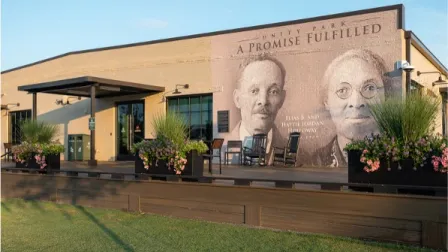
Still other fellows interviewed women about their sensory memories of “home,” worked on short films investigating relationships to language among Tibetan communities in India, and studied how issues of race play out in Greenville, South Carolina’s recent construction of a city park and in local governance models in both Philadelphia and St. Louis. Their projects traced the winding paths of diasporas, crossed linguistic lines and traversed domestic and international borders.
Even as they pursued a wide range of projects, the fellows were unified in underscoring how important it was to build ethical and sustainable partnerships with local organizations and communities. For Tsering Wangmo (Anthropology), examining the ways a researcher’s institutional affiliation might shape relationships with collaborators was actually a component of her project. Being mindful of similar dynamics compelled Malone to emphasize “prioritizing long-term, gradual, intentional relationship-building” that centers “genuine collaboration” over quick outputs. The Divided City Fellowship may only be for a summer, but several fellows are hopeful that their initiatives will continue to grow through the relationships they’ve built.
Another commonality among the fellows was a reflection on the ways the Divided City Fellowship complemented their usual graduate training and focus. Timi Alake, for instance, remarked that the fellowship program gave him a chance to “explore a different vantage of my dissertation.” The skills that fellows exercised throughout the program were also practical and transferable in nature. Several of them highlighted juggling a variety of logistical challenges that arose over the course of their projects. Because projects weren’t always smooth sailing, fellows were pushed to nimbly adapt to various challenges, from the hiccups of event planning and catering to the pressures of time constraints.
Perhaps most enthusiastically, though, the fellows welcomed the ways the Divided City Fellowship helped them build community. Wang noted that public engagement and local relationships helped “overcome a sense of isolation as PhD students,” a sentiment that other fellows affirmed.
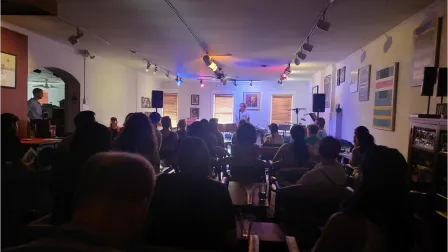
It turns out that non-academic publics similarly appreciate the community building these kinds of initiatives foster. For her project, Rebecca Hanssens-Reed organized an event that combined literary readings and performances in part to “get outside my own little bubble,” but she was taken aback by the unexpectedly “enormous turnout” from local St. Louisans. The night of her event, the audience spilled over to sit on the floor, even despite the summer heat. Afterwards, local bookstore Leviathan Books approached her with an offer to host the next gathering.
“There really is a hunger for this kind of event,” Hanssens-Reed said.
Naomi Kim is a PhD student in the Department of English and a Lynne Cooper Harvey Fellow in the Program in American Culture Studies. She is completing a mentored professional experience (MPE) in the Center for the Humanities in fall 2025.
Headline image: The design for the Lewis Collaborative mural that Stephanie Nebenfuehr and Edo Rosenblith collaborated on includes a variety of St. Louis-related images.