
Juana Torralbo Higuera is a Graduate Student Fellow in the Center for the Humanities and PhD student in Germanic Languages & Literatures in the Department of Comparative Literature and Thought.
In a time when constructed borders and enforced political units are showing their limitations in offering ways of belonging to us humans, the Saint Louis Art Museum’s exhibit Anselm Kiefer: Becoming the Sea is a proposal for an alternative form of belonging, one that makes us pause, look around and observe the natural landscape surrounding us. Kiefer’s alternative reminds us of the uniting and anchoring force of rivers that historically humans have sought and felt. This always productive metaphor of human existence shapes the narrative of Becoming the Sea. It is that sensation of becoming part of something larger, the same sensation that the visitor experiences when moving from the small galleries to the sculpture hall. There, surrounded by five imposing pieces, the Rhine meets the Mississippi, connecting visitors with other humans across the ocean. The experience of the hall also offers a historical voyage to connect with the Anishinaabe and Wabanaki peoples who were here, in what we call Missouri today, long before us, and were protectors of this same river. Paraphrasing curator Min Jung Kim’s closing remarks of the opening lecture of this venue, this exhibition achieves a collapse of time and space, diluting ends and beginnings, as history like water is never still, and water carries us and brings us to the infinity of the sea.
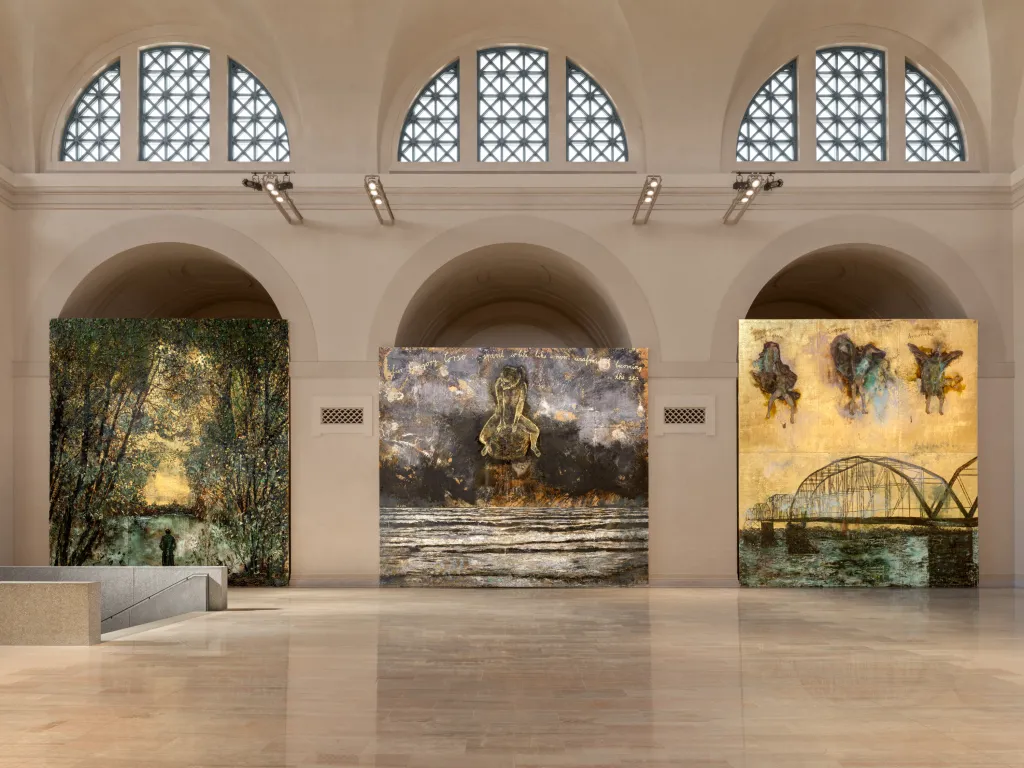
One of the morals of the exhibit’s narrative is a warning about the devastation and destruction that unquestioned ways of belonging cause in retaliation when under threat. Der Herbstes Runengespinst (Autumn’s Runic Weave) — a title nodding to Paul Celan’s oeuvre — depicts a vast open winter field where stacks of burnt books dominate the texture and the depth of the composition transforming this gallery into that moment of history that Kiefer has obsessively revisited for years: that very moment of absolute destruction when he was born in the last days of World War II.
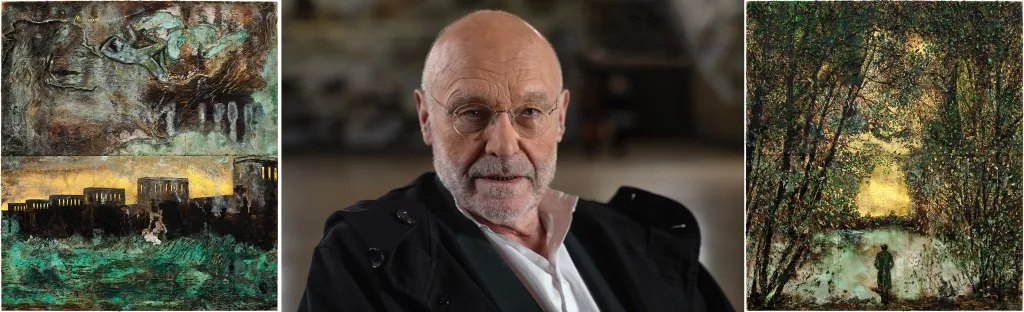
Center: Portrait of Anselm Kiefer; © Anselm Kiefer, Photo: Summer Taylor.
Right: Anselm Kiefer, German, born 1945; Anselm fuit hic (Anselm Was Here), 2024; emulsion, oil, acrylic, shellac, gold leaf and sediment of electrolysis on canvas; 30 feet 10 1/16 inches x 27 feet 6 11/16 inches; Collection of the artist and courtesy Gagosian 2025.309; © Anselm Kiefer, Photo: Nina Slavcheva. All images courtesy Saint Louis Art Museum.
Earlier common themes used by the artist such as destruction, renewal and transformation are also subtly integrated in this exhibit. In Becoming the Sea, the cycle of nature, the cycle of human life and the cycle of civilizations are foregrounded as reminders to visitors of the ephemerality of our own lives. Kiefer’s call to consider our belonging to bodies of water makes visitors ask themselves where one belongs. It is an attempt to reconnect with earthly elements, a call of nature that reminds us of our dependence on it, and humbles us about any attempt to dominate it. At the same time, by bringing us closer to river waters and by following the course of those waters, we are reminded of how we all belong to the same body of water. We all, sooner or later, no matter which river we belong to, end up mixing in, blending with one another and becoming the sea.
We all, sooner or later, no matter which river we belong to, end up mixing in, blending with one another and becoming the sea.
But before that, before that moment when we will become part of sea waters or part of the soil where other future sunflowers will blossom and grow, the narrative revisits and brings us to some pieces Kiefer produced in the 1970s that will appear unusual to those who are somehow familiar with his art. This vibrant and colorful gallery makes us reflect on how the woods meet the skies, how the I meets the you, how we together build a landscape and become part of a galaxy. How we love. How we are loved. And how we create love.
That’s life.
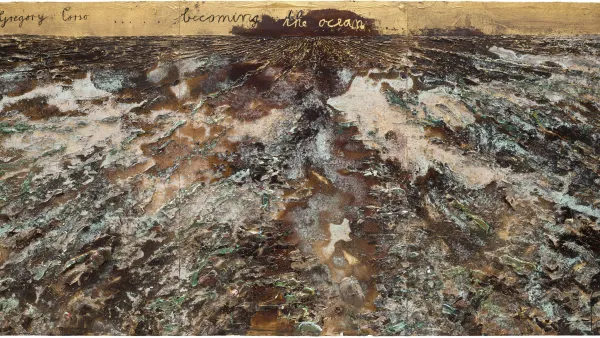
Headline image: Anselm Kiefer, German, born 1945; Becoming the ocean, for Gregory Corso, 2024; emulsion, oil, acrylic, shellac, sediment of electrolysis, gold leaf, stones and annealed wire on canvas; 110 1/4 inches x 18 feet 8 7/16 inches; Collection of the artist and courtesy Gagosian 2025.315; © Anselm Kiefer, Photo: Nina Slavcheva. Courtesy Saint Louis Art Museum.
