An ongoing project aims to facilitate a global exchange of ideas to improve advocacy for a future free of gender violence and discrimination
A photo portrait of Ivanna Aguilera recently graced the walls of the Centro Cultural Haroldo Conti in Buenos Aires as part of an exhibit celebrating gender diversity in Latin American football (soccer) fandom. It’s about 200 miles and a lifetime away from the cell in the notorious 121st Command Communications Battalion where, as a 13-year-old, she was held as a political prisoner of the 1970s-era Argentine military dictatorship, victimized for being part of the LGBTQ+ community. If they had intended to silence her, they failed. Aguilera went on to co-found the first sexual diversity organization in Córdoba and become head of the Trans-Travesti and Non-Binary area at the Universidad Nacional de Córdoba. After decades of advocacy on behalf of country’s trans community, Aguilera and fellow activists celebrated a big win in 2012 with the passage of a gender identity law, which established the right of individuals to legally self-define their gender. It’s the reason she travels today with a passport that matches her chosen identity.
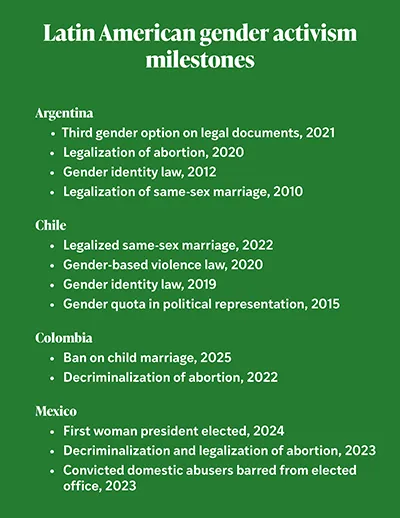
Aguilera will visit WashU to present at WashU’s Global Research Excellence Showcase on November 10 with fellow scholars Stephanie Kirk, professor of Spanish, comparative literature, and women, gender, and sexuality studies, WashU, and Paola Ehrmantraut, Endowed Chair in the Humanities, University of St. Thomas (and WashU alumna). They’re coordinating a project that aims to document gender activism by grassroots groups and academics in Latin America — a region that has seen meaningful feminist and LGBTQ+ victories in recent decades such as the decriminalization of abortion (Argentina, Colombia, Mexico), mandates for women’s legislative representation (Chile, Mexico) and legalization of same-sex marriage (Argentina, Chile).
“There is immense and coordinated gender activism in all of these countries,” said Stephanie Kirk, who is also director of the Center for the Humanities. “Collecting these stories will allow us to see the connections across movements and to recognize their difficult and sometimes dangerous work.”
At the heart of the project is an upcoming bilingual anthology titled “Saberes en movimiento: activismo de género en el espacio académico” (Knowledges in Movement: Gender Activism in the Academy). This collection will feature a rich mix of voices — personal narratives, interviews, visual essays, manifestos and more — all grounded in the lived experiences of those working at the intersection of activism and academia.
“While feminist knowledge has often circulated from North to South, the goal of our project is to offer Latin American writing by activists and academics working with activists as a blueprint for U.S. gender activism both within and outside the academy,” Kirk said. “We aim to document how Latin American activists, in collaboration with academics, have won concrete gains through sustained pressure and constant mobilization.”
The group, along with project partner Mónica Lloret Carrillo, a researcher at Tecnológico de Monterrey, has spent the last year traveling and meeting directly with organizations, scholars and community leaders across Latin America, thanks to funding from the Consortium of Humanities Centers and Institutes and a WashU Global Incubator Seed Grant. Using public humanities methods, they visited partners in their own spaces, listened to their insights and together mapped a plan for their participation in the project’s outcomes.
Meeting in person, on the ground, is essential to the project’s success, Kirk said. Over hours-long conversations, they’ve been able to assure potential collaborators of their intentions and to develop relationships. “These visits are crucial for building trust with community groups who have often been disadvantaged in their dealings with academia,” she said. “You have to be there to listen.”
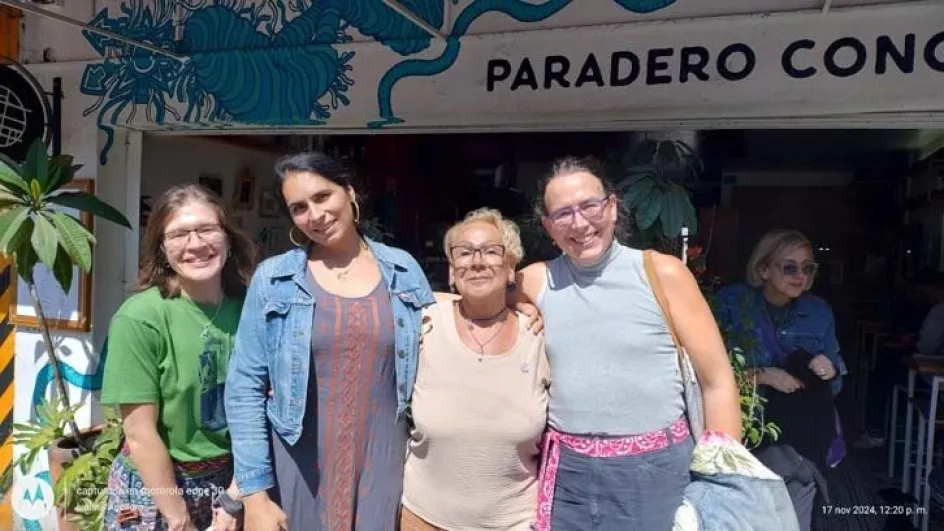
Their first stop was Mexico City in November 2024, where they were joined by Paco Tijerina, a PhD candidate in the Hispanic studies at WashU. There, they connected with several anthology contributors:
- Transsalud, an organization that provides healthcare and support for trans communities, led by a physician-philosopher-activist;
- La Nopalera, a rural feminist collective focused on ancestral agriculture;
- Antimonumenta, a group responsible for the installation of a protest monument honoring victims of femicide on the city’s main thoroughfare; and
- Restauradoras con Glitter, a cadre of artists, architects, historians and conservation specialists who defend feminist and anti-gender violence street art.
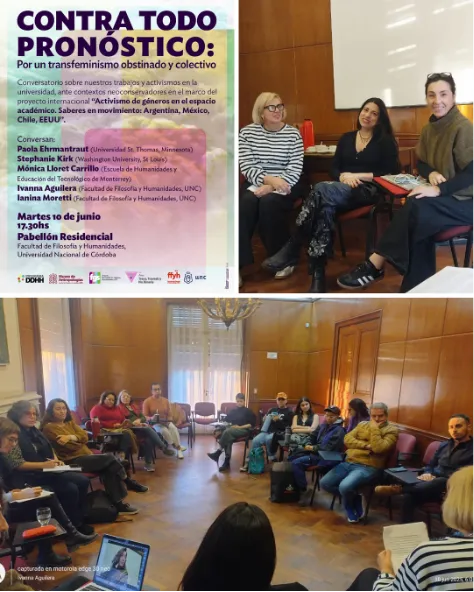
In May 2025, the group traveled to Córdoba, Argentina (Aguilera’s home base and Ehrmantraut’s hometown), for a series of meetings and events. Among the contacts they made were rural trans activist Cassandra Sandoval, host of global radio show Territorio Diverso; trans activists from Flores Diversas, an organization that offers workshops for trans people to support them in the workplace and other societal questions; and intergenerational feminist collective Alerta Torta, which focuses on lesbian identities.
On their last day in Córdoba as a group, they attended a conversatorio (community dialogue) organized by the Museum of Anthropology at the National University of Córdoba as special guests of trans activist Juani López, who is casqui-curaca of the Indigenous community Hijos del Sol Comechingón.
The group reassembled in June in Santiago, Chile, where they met with scholar-activist Andrea Jeftanovic and held discussions at the Universidad de Santiago with students, faculty and feminist organizers. These conversations focused on how to ethically and effectively collaborate between universities and activist communities — insights that will be included in the anthology.
They also visited Chile’s National Archives, where they explored feminist and LGBTQ+ history collections, including records from MEMCH (the Movement for the Emancipation of Chilean Women) and materials from Afrodita, a trans union working to preserve their collective memory. Additionally, they met with sociologist Natalia Sánchez, a founder of Casa Mujeres y Diversidades Ester Váldez, a pioneering space on the outskirts of Santiago, dedicated to the support of gender-diverse individuals.
The group plans to continue to tell the story of gender activism in Latin America with a future trip to Colombia. There, they will meet with activists and academics in Medellín and Bogotá, where the peace process — an accord between the government and the Revolutionary Armed Forces of Colombia to end decades of violence — adds another dimension to the work they do.
When they return, the group will begin the process of assembling the volume. By necessity, Kirk expects the project will unfold slowly, especially as local conditions shift. Despite some successes, gender activism in Latin America continues to contend with high levels of gender violence and harmful political rhetoric. Upcoming elections in several countries could roll back progress activists have made, much like has happened in the U.S.
“We’re working with people whose identities are under threat or the work they do is dangerous,” Kirk said. “We hope to foster a sense of hemispheric solidarity.”
Headline image: Young women march in celebration of Argentina’s 2018 decriminalization of abortion waving green bandanas, which have become a symbol of the Green Wave, a decentralized but coordinated set of abortion-rights movements across Latin America. Legalization of the procedure came two years later. Photo by Soyyosoycocomiel via Wikipedia.