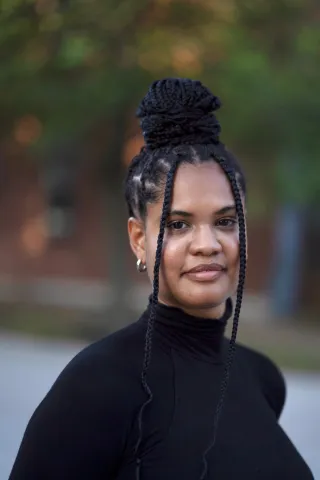
The Center for the Humanities is pleased to welcome Candace Borders, scholar of race, gender and class in the Midwest, to the WashU community. Borders recently joined the center as a postdoctoral fellow in the Modeling Interdisciplinary Inquiry program. This two-year Mellon-funded program is designed to encourage interdisciplinary scholarship and teaching across the humanities and interpretive social sciences.
Borders earned a PhD in American studies and African American studies from Yale University in 2025. She studies the history of Black women’s public housing activism in St. Louis, and she is also a ceramicist, crocheter, yoga instructor and reader.
Below, we asked Borders about her research, her experiences attending WashU as an undergraduate student and her postdoc plans.
Tell us a little bit about yourself! What place or places do you call “home,” and what do you enjoy doing outside of work?
I am originally from Cincinnati, Ohio, and consider myself a Midwestern girl at heart. I’ve lived on the East Coast (in big and small cities), but the Midwest is always home for me — and I consider St. Louis a second home.
Outside of writing about Black women’s experiences in St. Louis public housing, I am a ceramicist, crocheter, certified yoga instructor and avid reader of trashy romance novels. My Kindle is never far out of reach! I also love thrifting and hunting for vintage treasures. On the weekends I am usually hanging out with my partner’s kids, watching movies, trying to keep up with them on Roblox and putting together their newest Lego toy.
What are your academic interests? What drew you to these topics?
My research interests broadly sit at the nexus of race, gender, class and the urban Midwest. I am particularly interested in the strategies African American women use to both make calls upon the state while opposing the structural logics of racial hierarchies. This interest started my sophomore year at WashU when I took a class with Professor Clarissa Hayward on racial justice and the city. I became fascinated with the history of St. Louis’ Pruitt-Igoe public housing project. We watched the wonderful documentary The Pruitt-Igoe Myth, and I had gone on a couple of walking tours of the former public housing site. As I learned more about the history of mid-20th-century high-rise public housing across the U.S. and the apparatuses of the welfare state, I knew I wanted to write about the Black women who lived in Pruitt-Igoe.
My senior year — as a Mellon Mays Undergraduate Fellow — I wrote a thesis based on oral history interviews I conducted with former residents who were generous enough to speak with a baby scholar. Eight years, more interviews and a lot of archival research later, that work has developed into my dissertation, a much broader and — I like to think — more well-written history of Black women’s public housing activism in St. Louis.
You’ve previously worked as a gallery teacher, and you also have curatorial experience. How does your work with art museums interact with or shape your scholarly goals?
My experience conducting oral history interviews directly influenced my interest in public humanities. And critically interrogating the politics of knowledge production has been central to my work both within and beyond the academy. Who can create knowledge? How do the knowledge systems we live in control not just what we know, but how we know? I have found that my experiences working and teaching at museums — both the Contemporary Art Museum St. Louis and Yale University Art Gallery — deeply inform how I think about these questions in my scholarship.
Most recently, I curated an exhibition here on campus — Our Only Hope: Black Women and the 1969 Rent Strike — grounded in one of my dissertation chapters that follows the Black women-led public housing rent strike. Based on archival materials I found in WashU Special Collections, the exhibition followed Black women living across public housing complexes in St. Louis as they successfully organized what was at the time the largest and longest-running public housing rent strike in the U.S.
You attended WashU as an undergraduate student and are now returning as a postdoc! How does it feel to be back, and what will you be working on during your postdoc?
There is something very humbling and cyclical about being back at WashU, what I consider to be the site of my “scholarly awakening.” I am thrilled to be back on campus, in St. Louis, and especially at the humanities center. Currently, I have a journal article under review focusing on what I frame as Black women’s quotidian strategies of refusal against the mid-20th-century welfare apparatus. I am also working on my first book, which is an extension of the dissertation.
In collaboration with my friend and fellow postdoc Daisy Reid’s conference panel on plantation ecologies and their more-than-human afterlives, I will be presenting a paper on the racializing ecologies of St. Louis public housing in the spring. I am perhaps most immediately excited about the undergraduate course I will be teaching next semester in the Department of African and African American Studies: “Urban Inequality: Racism, Segregation and Ghettoization in the American City.” The course will be grounded in the rich, local history of St. Louis with frequent visits to our campus archives — stay tuned for this!
About the author
Naomi Kim is a PhD student in the Department of English and a Lynne Cooper Harvey Fellow in the Program in American Culture Studies. She is completing a mentored professional experience (MPE) in the Center for the Humanities in fall 2025.