Interview with Faculty Fellow Elizabeth C. Childs
When Paul Gauguin died almost 125 years ago, his artistic reputation did not assume the global stature it would later attain. Though well known within certain circles of the Parisian avant-garde, he lived out his final years in relative isolation in Polynesia, with limited awareness among the broader French art world of his work or its ambitions. The story of how Gauguin’s art moved from this relative obscurity to a defining position in narratives of European modernism — through dealers, exhibitions, collectors and shifting critical attitudes — reveals how profoundly his legacy was shaped after his lifetime. With her current book project, “Gauguin’s Afterlives: Global Legacies, Canons and Critiques,” Elizabeth Childs, the Etta and Mark Steinberg Professor of Art History, is writing the first comprehensive study of the shifting meanings and evaluations of Gauguin’s art in multiple social, political and cultural contexts since his death. The publication will reveal why Gauguin remains a figure whose work continues to prompt new questions, controversies and reassessments, and why his place in art history remains both central and contested. Below, she gives us an early look at the project.

Gauguin is shown posing before his painting Te Faaturuma at his 1893 Durand-Ruel exhibition. Courtesy Larousse Archives.
How was Gauguin regarded at the time of his death? Was he widely known?
At the time of his death in 1903 on the island of Hiva Oa in the Marquesas Islands, Gauguin was locally known well by only a few personal friends and by the Catholic mission and the French colonial administrators, against whom he railed while advocating for legal rights of the region’s indigenous people.
His legacy would have probably collapsed in the early 20th century into a local tale of an eccentric colonial resident were he not already deeply ensconced in the art networks of Paris. In France, he was quite well known among fellow artists, dealers and collectors with whom he exchanged letters and to whom he shipped the artworks he made while in Polynesia from 1891 to 1893 and 1895 to 1903.
He had made a contract with Ambroise Vollard to send paintings back in exchange for the modest monthly stipend that literally was his livelihood, and that work indeed found its audience, including with a young Henri Matisse. Moreover, Gauguin’s Impressionist era work was already well-placed in a variety of collections in Paris, such as that of his friend and interlocutor Edgar Degas and the lesser-known Émile Schuffenecker. His estranged wife, Mette, had returned to Copenhagen and circulated his work, helping to build his critical reputation and art market viability.
But his reputation beyond Denmark and France and its colonies was not spreading widely in the later years of his life. That was the work of the dealer market system, which sold not only Gauguin’s art but his story.
Can you give us a glimpse at some of the significant moments that introduced him to the world and have since shaped his legacy?
The driving force behind the emergence and growth of Gauguin’s posthumous reputation was the art market of Paris: the dealer who sold his work locally and abroad and the collectors who invested heavily in the artist.

Key exhibitions of Gauguin’s Polynesia works in Paris took place in his lifetime in 1897 at Vollard’s gallery, to mixed acclaim. After Gauguin’s death, Vollard put together important exhibitions for the Paris art world: first in 1903 at the Salon D’automne and then a more substantial retrospective, at the same venue, in 1906, with a staggering 227 works on display. At these shows, artists including Matisse, Picasso and the visiting German artist Paula Modersohn-Becker were all deeply impressed by Gauguin’s art.
After that, a significant moment of opening Gauguin’s work to a broader European audience happened with the Grafton Gallery show in London in 1910. Here, the term “Post-Impressionist” was first coined to describe breakthrough modernist work by Gauguin, Van Gogh and more, a moniker that has followed him ever since. Many of these works then crossed the Atlantic to appear in the famed Armory Shows of European modern art in New York and Chicago (among other venues) in 1913. These exhibits consolidated Gauguin as a leading modernist for his use of high color, thin paint surfaces, seeing nature through a filter of a Symbolist imagination and the fabulations of his primitivist imagery of Tahiti. Several exhibitions at the Museum of Modern Art in New York, starting with one in 1929 that featured the key ”Post-Impressionists” Cézanne, Gauguin, Seurat and Van Gogh, cemented Gauguin as a cornerstone in the American telling of the unfolding of European modernism.
How was he received by Polynesians? Has this view changed over time?
In his own time, Polynesians encountered more of Gauguin the individual Frenchman than Gauguin the avant-garde artist who crafted his career with the Impressionists and Symbolists in Paris. He was tolerated as a foreigner who might bring with him some wealth from France — a wildly misplaced hope in his case.
There was minimal interest in Gauguin’s art by Tahitians for many years. A small 20th-century Gauguin Museum in Tahiti, which catered to tourists and school groups, offered a tiny group of authentic prints and numerous reproductions near one of the towns where he had lived. Similarly, a Gauguin Cultural Center in the Marquesas displayed boldly painted reproductions and a timeline for visitors; that facility is now fortunately being repurposed to the needs of the local Marquesan artistic community. Gauguin has primarily been valued in the 20th century by the broader Polynesian culture as an asset to lure global visitors, claiming his story as a resource that could generate a steady stream of interest in the location and welcome tourist income.
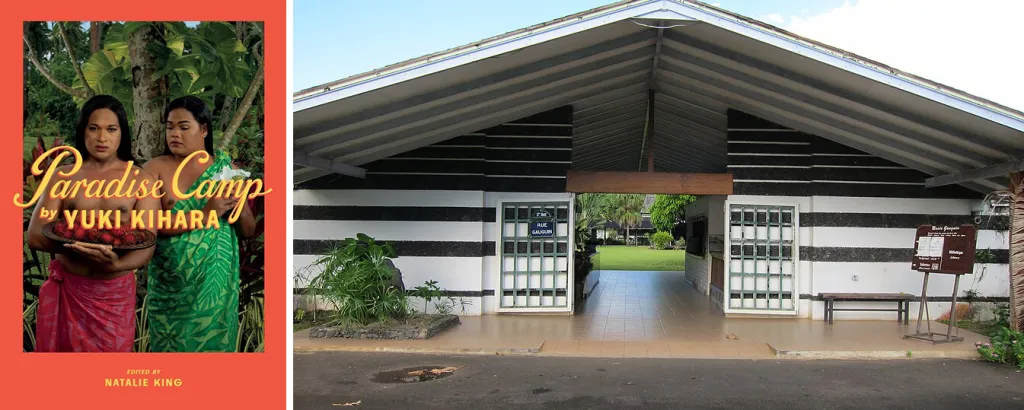
However, in recent decades, some contemporary Pacific Islander artists and filmmakers have taken on the legacy, offering critique and taking back the images produced by Gauguin to put these paradisiacal notions to decidedly local and contemporary uses. Their work addresses Gauguin’s trademark images to probe legacies of colonial image-making and to invert the stories to make the Islanders the protagonists and agents of the scenes, rather than the objectified subject of the artwork. Notable among them is Samoan artist Yuki Kihara, who displayed her exhibition Paradise Camp at the New Zealand Pavilion at the Venice Biennale of 2022. There, she displayed numerous photographic montages, loosely based on Gauguin’s paintings but repurposed the images to foreground the Samoan fa’afafine (third-gender) community, of which she is a member.
You have returned to the subject of Gauguin many times over your career. Why does he continue to attract your scholarly interest?
The example of, and the problem of, Gauguin’s art constantly offers new areas for rethinking what we think we know about a significant artist in the history of European modern art. Part of the ever-revising attention to his work derives from how embedded it is in the Euro-American canon of modernism, a notion of significance that has played out in the galleries and art markets ranging from Paris, New York and London to Moscow, Brazil and Qatar.
The work itself is varied — a robust oeuvre of paintings, sculptures, prints and writing generated between 1880 and 1903. He was in Paris when Impressionism was taking off; he participated in the development of Cloissonisme and Synthetism in Brittany; and he clarified his ideas in the company of Vincent Van Gogh during an intense nine-week period in Arles known as the Studio of the South. Ever peripatetic, he left Paris to pursue a Frenchman’s colonial fantasy of living within the tropics to find both an alternative to the “tired” subjects of urban Impressionism and to forge what he lauded as a new path for modern art.
What intrigues me is trying to bring all that together — to see how these stories are true simultaneously, in a diverse, well-informed art world that brings so many questions to bear on this corpus of art.
There has been for me always a new question to ask about his connections to the thinkers, poets, artists, critics and collectors of his time. Feminist inquiry has led us to confront his problematic relationship to Pacific Islander women who served as subjects, models and domestic partners. Cultural geography has asked us to locate Gauguin within an imaginary of notions of the Pacific. The art market requires us to ponder how deeply valued his work still is on international markets, when one of his Tahitian canvases can sell for well over $200 million to an art museum in Qatar. Yet the art world is diverse — while some clamor to buy the work at auction, others propose to “cancel” Gauguin, to remove the work from art museums due to the exploitative relationships he had with some younger women in the colonial context.
What intrigues me is trying to bring all that together — to see how these stories are true simultaneously, in a diverse, well-informed art world that brings so many questions to bear on this corpus of art.
Headline image: Where Do We Come From? What Are We? Where Are We Going? (1898) by Paul Gauguin. Courtesy the Museum of Fine Arts, Boston.