Interview with Faculty Fellow Christine Johnson
If Voltaire was right when he famously wrote in 1756 that the Holy Roman Empire, which then dominated Central Europe, was “neither holy, Roman, nor an empire,” what was it, then, that held together the disparate lands and people that constituted the area we now call Germany? Or, indeed, did they see themselves as having a unified region or identity at all? Christine Johnson, associate professor of history and a Faculty Fellow in the Center for the Humanities, explores these questions in her current book project, “The German Nation and the Holy Roman Empire, 1440-1556.” With her study, she aims to reshape our understanding of how Germany came into being in political as well as intellectual terms.
Briefly, what is your book about?
I’m exploring what political identity looked like in Central Europe in the Renaissance, where governing happened through the institutions of the Holy Roman Empire, which traced its roots back to ancient Rome and claimed authority over territories with many different peoples and languages. At the same time, political and cultural elites referred to and elaborated on ideas of “German” lands, peoples and history that were connected to, but didn’t overlap neatly with, the Empire.
This complexity helps us see how national identity worked under more fluid circumstances where you don’t have the modern-day “nation-state” template. The first few chapters will look at aspects now strongly associated with nationalism — history, borders, language — and show how people navigated the possibilities and contradictions of having both the Empire and the nation as reference points. The last chapters explore how these dynamics played out during the Protestant Reformation, when the Emperor and many German princes found themselves on opposite sides of this bitter conflict.
Your book project examines a slice of the Holy Roman Empire period (1440-1556). What is important to know about the dates you’ve chosen?
The year 1440 is the start of the Habsburg dynasty’s long-term tenure as Holy Roman Emperors, when the Duke of Austria is elected as Frederick III. He’s followed by his son, Maximilian I, who is also ruler of the Low Countries, and Maximilian’s grandson, Charles V, who is also King of Spain. In the mid 15th century as well, Gutenberg establishes the first printing press in Europe, which spreads quickly (especially in Central Europe) and changes how political arguments unfold and ideas spread. At the same time, humanism, an intellectual movement based on the recovery of ancient Greek and Roman culture, gains a lot of adherents, who now have a new set of expectations about how politics should be conducted, what proper history looks like, and what might make a nation or Empire important.
So, you have important elements put into place whose implications will be worked out over the next decades. And then comes Martin Luther’s challenge to the Roman Catholic Church, which builds on some of these dynamics before, in the end, fundamentally changing the way both Empire and nation are viewed. So, I end in 1556 when, following the Peace of Augsburg, through which the Empire was split between Protestant and Catholic territories, Charles V abdicated the imperial throne in favor of his brother Ferdinand, and the possibilities for both the Empire and German identity had to adapt to this new religious and political order.
Paint us a picture of the territories that constituted German lands during the Holy Roman Empire.
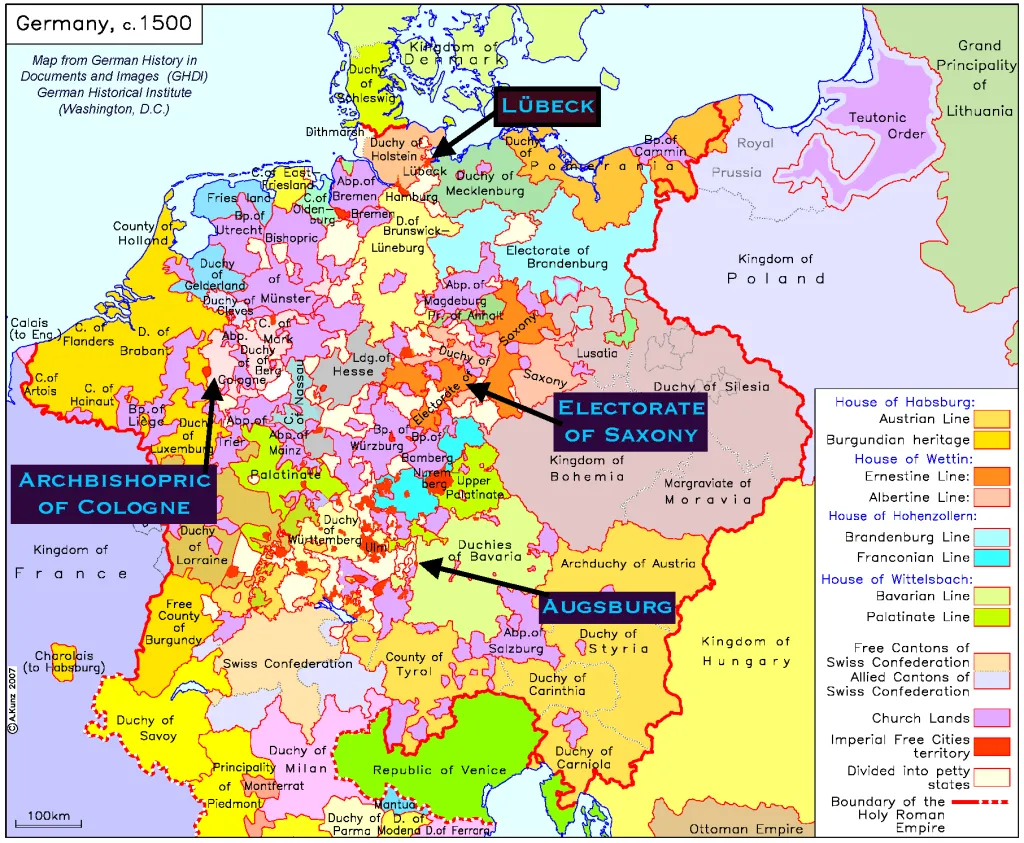
The Holy Roman Empire was made up of more than 300 individual units, from large territories such as Brandenburg and Bavaria to the very small holdings of individual Imperial Knights, to self-governing cities ranging in size from a few thousand people to more than 50,000. And there was no uniformity, because each unit’s place within this system — how it related to the Emperor and to its neighbors, what rules applied to it and when — was determined by its unique history.
To make my archival research manageable, I’m concentrating on four places: the Free Imperial Cities of Augsburg and Lübeck, the Archbishopric of Cologne and Electoral Saxony.
Augsburg and Lübeck were both prominent commercial cities, but Augsburg was close to the Habsburg lands and to the Alps, so it was closely connected to the Emperor and to Italy, while Lübeck was a member of the powerful Hanseatic League that dominated trade in the Baltic Sea and included cities throughout the region. The Archbishop of Cologne, meanwhile, wasn’t just a church official, but the ruler of a sizable territory that, given how things worked in the Holy Roman Empire, did not include the city of Cologne. Furthermore, like the Elector of Saxony, the Archbishop was an Elector — one of seven princes who elected the next Holy Roman Emperor. Each of these places is situated differently within the German lands and with regard to the Empire.
Tell us about your archival research. What sources are you looking at (and where)? Have you found anything particularly surprising?
One of my key findings is that much of the business and correspondence that occupied these cities and territories did not involve or invoke either Germany or the Empire as a point of reference. They are concerned with local matters and disputes or with coordination among neighboring territories to respond to a regional issue (usually the trouble caused by yet another neighbor). Given what we know about how local governments work (even today) and the importance of autonomy within the Empire, this finding makes sense.
But it means that when I’m looking through file folders titled “Proceedings of the Regional Diets, 1521-1546” or “Augsburg and the Emperor: Printed Mandates from Emperor Maximilian I. to Emperor Rudolf II” and a document mentions the German nation or the German lands, for example, that there is a specific reason for it.
One of the most telling set of documents concerns the Peasants’ War in 1525, a broad peasant uprising against their lords within Central Europe. The city councils and territorial rulers, who usually are hesitant to commit to any binding course of action or larger purpose, are now constantly updating each other on their plans to combat this threat to the German lands (including, most importantly, their own). At the same time, these records include reports on what the peasants say they want, including a document that imagines a “Christian Union” as the desired political system — so, an idea of a “larger unit of cohesion” that eschews the existing Empire and Germany entirely.
One of the benefits of studying the premodern period is that it highlights how many things that seem self-evident in the modern world are not, in fact, natural and obvious ways of organizing society.
What will this study add to our understanding about how national identity could intersect with larger units of cohesion (such as the European Union)?
First, it broadens our understanding of national identity beyond the exclusionary claims of the modern nation-state. Even the European Union is organized as a community of states: You are a citizen of Ireland, and therefore a citizen of the European Union. And Members of the European Parliament are elected through national elections, although they don’t vote as a country once in the EP. But what if historical or geographical connections were used to make constituencies — for example, the Danube River Basin or areas where minority languages are spoken? I’m certainly not advocating for the recreation of the Holy Roman Empire, but some rethinking of how our political communities are organized seems overdue, especially given nationalist authoritarian movements like Orban’s in Hungary.
Writers conceived of German history as porous and multivalent, and people living in the German lands developed political commitments in the absence of strict borders (contrary to Donald Trump’s comment that “if you don’t have borders, you don’t have a country”). One of the benefits of studying the premodern period is that it highlights how many things that seem self-evident in the modern world are not, in fact, natural and obvious ways of organizing society.
Another benefit of studying this political moment in Central Europe is that we can see how structures of exclusion work even when political communities are envisioned capaciously. In interweaving or juxtaposing the history of the Germans and the history of the Empire, for example, authors never include the Jewish communities living in their midst. The reformers’ ideas about German liberty and the right of resistance against a tyrannical government never thought that these questions related to marginalized and oppressed Jewish communities. So, who gets to be European now and speak for European values?
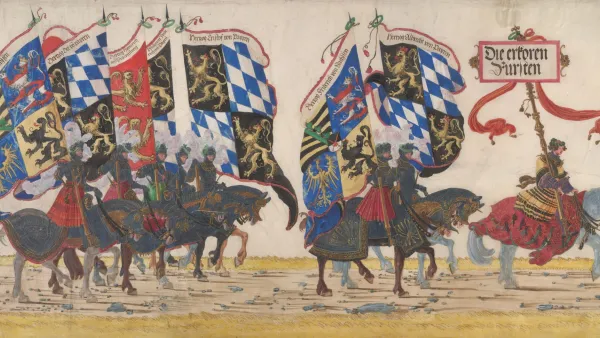
Headline image: “The German Princes” (Albrecht Altdorfer, c. 1512-1515), part of a series of woodcuts, The Triumphal Procession, commissioned by Holy Roman Emperor Maximilian I.